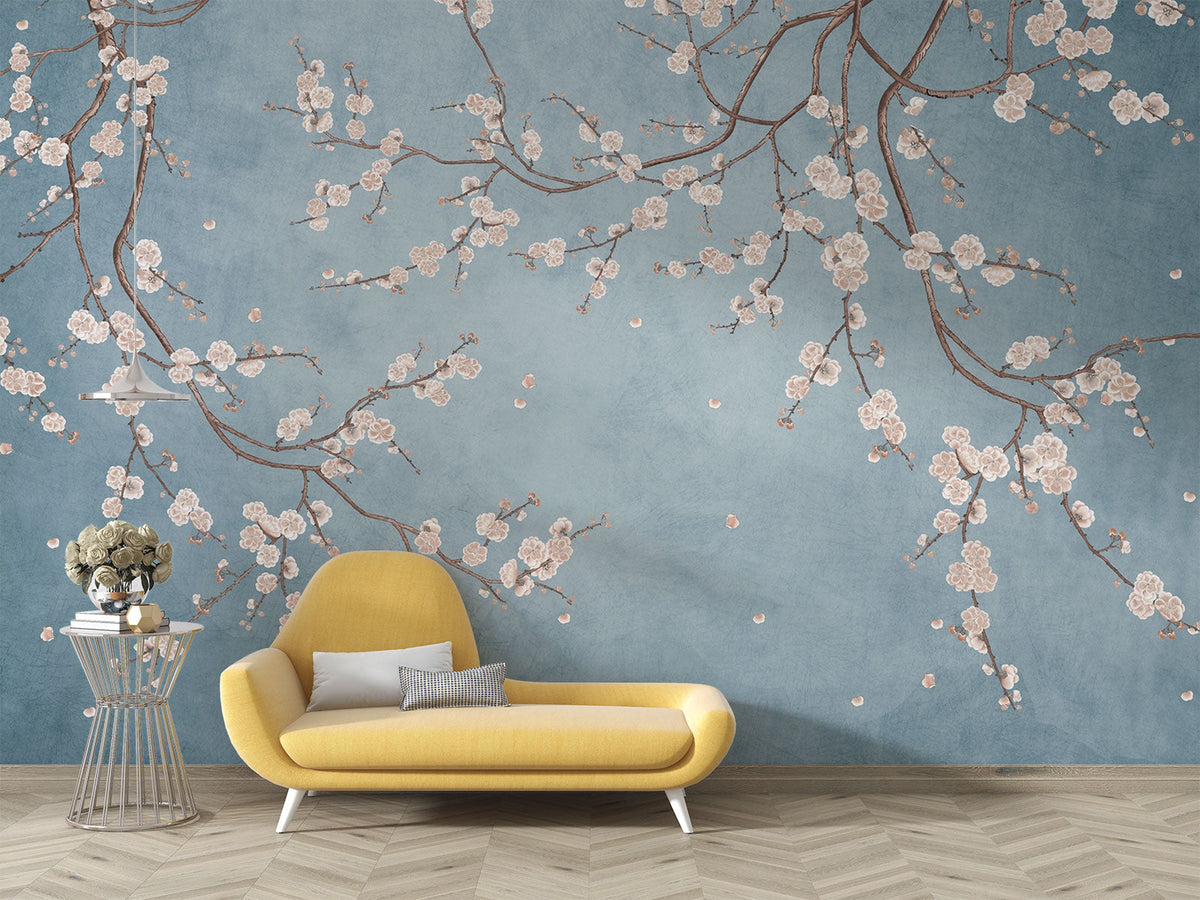
Chinoiserie vs Art Nouveau Wall Murals: What’s the Difference?
Put a Chinoiserie mural beside an Art Nouveau design and, at first glance, they can seem surprisingly similar. Both are full of flowers, leaves, birds and decorative detail. Both can feel elegant, romantic and a little removed from the minimalism that has dominated interiors for the past few years.
But they create very different rooms.
A Chinoiserie mural often feels as though you are looking into a garden or landscape. Art Nouveau tends to feel more like the design itself is growing across the wall.
That difference is a useful place to start if you love both styles but aren't sure which one will work best in your home.
What is Chinoiserie?
Chinoiserie has a long and rather interesting history.
The style developed in Europe from fascination with art and decorative objects arriving from China and other parts of East Asia. By the 18th century, European designers were creating their own imagined versions of these influences, often combining flowering trees, birds, landscapes, pagodas and ornamental details into elaborate decorative scenes.
It is worth making the distinction that Chinoiserie is not simply traditional Chinese art. Historically, it was a European interpretation of East Asian design, sometimes accurate and sometimes highly fanciful.
Wallpaper became particularly important to the style. Early Chinese wallpapers arriving in Europe featured hand-painted landscapes, flowering trees, birds and butterflies, often arranged as continuous scenes rather than repeating patterns.
That scenic quality is still one of the things people respond to most strongly today.
Our Chinoiserie wallpaper mural collection ranges from quiet blossom designs to much darker and more dramatic interpretations.
The Navy Chinoiserie Cherry Blossom Wall Mural, for example, uses delicate pale blossom against a deep blue background, while the Golden Chinoiserie Peacock & Egret Wall Mural has a much richer, more decorative character.
Same broad family of design, completely different atmosphere.

What is Art Nouveau?
Art Nouveau arrived much later, flourishing from the late 19th century into the early years of the 20th century.
Nature was central to it, but Art Nouveau artists did not usually try to reproduce nature literally. Flowers, stems, insects, hair and even the human figure were stretched and stylised into long, flowing forms.
One of the style's most recognisable features is the whiplash curve: an energetic, sweeping line that bends, twists and seems to keep moving.
You can see that idea throughout our Art Nouveau wallpaper mural collection. Designs such as the Art Nouveau Botanical Wall Mural use vegetation as part of the structure of the artwork rather than simply placing flowers within a landscape.
That is probably the easiest distinction between the two styles.

Chinoiserie often creates a scene. Art Nouveau creates a rhythm.
The difference becomes clearer when you look at the wall as a whole
Imagine a large wall behind a bed.
With Chinoiserie, you might have branches entering from one side, birds sitting among blossom and open areas of background between them. Your eye travels through the scene almost as if you are looking through a window.
A mural such as the Japandi Magnolia & Bird Wall Mural is a good example of the quieter end of this approach. It has plenty of breathing room and works particularly well if you want the mural to feel calm rather than highly decorative.
Art Nouveau approaches that same wall differently.
Instead of a landscape, the stems and flowers might curl around one another, creating an ornamental composition across the entire surface. Something like the Art Nouveau Floral Wall Mural feels more like a piece of decorative art enlarged to architectural scale.
Neither approach is better. They simply make the wall behave differently within the room.
Chinoiserie tends to tell more of a story
This is one reason Chinoiserie works so well as a mural.
There is often something happening within the picture: birds in flight, cranes among branches, a peacock beneath flowering trees or a quiet garden disappearing into the distance.
Some designs are romantic and delicate. Others can become surprisingly dramatic.
Our Dark Crane Chinoiserie Wall Mural, for example, is almost the opposite of the soft pastel image people sometimes associate with Chinoiserie. The dark background and pale cranes create a much stronger, more graphic focal point.
That variety means the word Chinoiserie describes a design tradition rather than one particular colour palette.
You can have Chinoiserie in dusty blue, teal, ivory, gold, burgundy, black or warm neutral colours and still retain the characteristic botanical and scenic quality.
Art Nouveau is more about line and form
With Art Nouveau, I would look less at the subject and more at how it has been drawn.
An iris in a conventional floral design is simply an iris.
In an Art Nouveau design, the stem might stretch across half the composition, curve around another flower and become part of a larger flowing pattern. Leaves, petals and decorative borders often merge into one another.
That makes Art Nouveau particularly effective when you want a wall to feel artistic without necessarily creating the illusion of a landscape.
Some designs are restrained and botanical. Others use rich colour, gold details, human figures or the poster-like aesthetic associated with artists such as Alphonse Mucha.
There is quite a wide spectrum.
Which style works better in a bedroom?
Both can work beautifully, but I would choose according to the feeling you want when you enter the room.
For a softer bedroom, Chinoiserie designs with pale backgrounds, blossom and open space are easy to live with. They give you detail when you look closely without making every part of the wall visually busy.
The Japandi Magnolia design is a good example.
If the bedroom is intentionally darker or more luxurious, navy, burgundy or deep teal Chinoiserie can create a much more enveloping atmosphere.
Art Nouveau works particularly well when you want the mural itself to feel like the decorative centrepiece of the room. Flowing botanical designs behind a bed can give you the effect of a very large piece of artwork without needing additional wall decoration around it.
What about a living room or dining room?
This is where I think the bolder versions of both styles become particularly interesting.
A dining room can carry a surprising amount of visual detail, especially if the rest of the furnishings are relatively simple. Golden Chinoiserie, peacocks, cranes and larger botanical landscapes can feel quite at home here.
The Golden Chinoiserie Peacock & Egret Wall Mural is the kind of design I would consider for a room where the mural is intended to be noticed immediately.
Art Nouveau can achieve the same impact in a different way. Instead of creating depth through a landscape, its decorative lines and botanical forms make the wall itself feel ornamental.
In either case, you do not necessarily need to decorate the rest of the room to match the mural literally. Often the most effective approach is to pick out just one or two colours from the artwork for cushions, upholstery or accessories and leave the rest fairly restrained.
What if you like both?
You don't really have to choose a stylistic camp.
Contemporary interiors borrow freely from different periods, and some murals naturally sit somewhere between several influences.
If what attracts you to Chinoiserie is the blossom and botanical detail rather than its more elaborate landscapes, you may also enjoy the organic forms of Art Nouveau.
Likewise, if you like Art Nouveau because of its connection with nature but find highly ornamental designs too elaborate, a restrained Chinoiserie landscape might give you the atmosphere you want with more open space.
I would start by asking one simple question:
Do you want to feel as though you're looking into a scene, or do you want the artwork itself to flow across the wall?
If the answer is a scene, start with Chinoiserie wallpaper murals.
If the answer is flowing decorative artwork, explore the Art Nouveau wallpaper mural collection.
Scale matters as much as style
One final point is easy to overlook when choosing a mural online.
The same artwork can feel completely different depending on the proportions of your wall.
A wide dining-room wall may reveal far more of a landscape, while a narrow bedroom wall might concentrate attention on one branch, flower or figure.
That is why our murals are made to measure rather than sold only in fixed sizes. You enter your wall dimensions and can position the artwork before ordering, so you can decide which part of the design becomes the focal point.
We normally recommend allowing approximately 10 cm / 4 inches extra in both width and height so there is room for trimming during installation.
It is a small practical detail, but getting the composition and scale right often makes a bigger difference than choosing between two very similar colours.
So, Chinoiserie or Art Nouveau?
If you love elegant interiors, botanical detail and artwork with a sense of history, both are worth exploring.
Choose Chinoiserie if you are drawn to scenic gardens, flowering branches, birds and landscapes, or if you want the wall to feel like a view into another place.
Choose Art Nouveau if you prefer flowing lines, stylised flowers and decorative compositions where the movement of the design is as important as the subject itself.
And if you still can't decide, that probably means you have found the interesting part: the point where the two styles begin to overlap.
Explore our Chinoiserie wallpaper murals or browse the Art Nouveau wallpaper mural collection to compare them side by side.