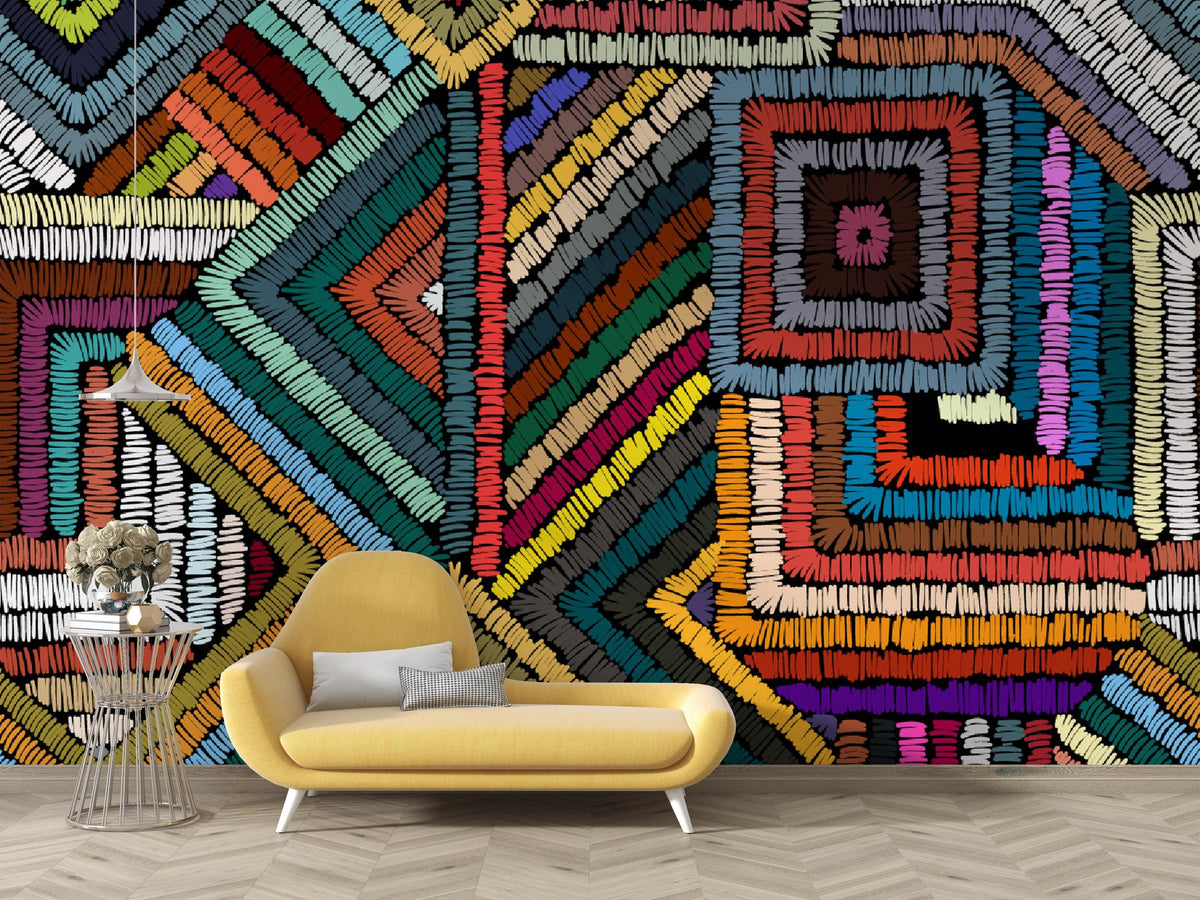
Geometric wall murals can be bold and colourful, soft and understated, or somewhere between the two. The difference comes from the size of the shapes, the contrast between colours and how much of the pattern you see once furniture is in place.
Rather than choosing a design in isolation, start with the wall, the room’s existing colours and the effect you want the artwork to have.
Decide how much contrast you want
A mural with sharply contrasting shapes can become the main visual feature in a room. That may suit a living room with plain upholstery or an office with simple furniture. A more restrained palette is worth considering when the room already contains patterned textiles, colourful artwork or open shelving.
Our Geometric Wallpaper Mural collection brings together different approaches, including Earthy Geometric, Black and White Geometric Pattern and Bauhaus Geometric. Compare them alongside the colours already present in your room, rather than judging each on a blank screen.
Choose an earthy palette or a stronger graphic statement
For an earthy scheme, compare muted colours against timber, upholstery and the room’s existing paint. Keep one physical sample beside those finishes rather than choosing from separate photographs taken in different lighting.
For a more expressive room, compare clear colour blocks and large shapes. Start with a wall that has enough uninterrupted space to show the composition. You can add personality through one strong surface without repeating bold patterns across every furnishing.
Consider a Bauhaus-inspired statement
The Bauhaus Geometric Wallpaper Mural uses a bold circular composition. It is an option when you want the wall to read as a large graphic artwork.
Try taking one accent colour from the mural into a cushion, lamp or chair. Keeping the remaining finishes relatively simple can make the shapes easier to appreciate. You do not need every object in the room to follow the same geometric theme.
Judge scale against your furniture
A small preview can make large shapes look deceptively modest. Review the design at your intended wall dimensions and consider where the largest circles, blocks or lines will sit.
Behind a sofa, look at the artwork that remains above the backrest. Behind a bed, check how the headboard divides the composition. For a dining area, consider both the view with chairs tucked in and the view when people are seated.
There is no single pattern size that suits every small room. Compare the actual crop and visible wall area instead of assuming that small shapes are always the better choice.
Does a geometric mural repeat like wallpaper?
Check the individual design rather than assuming that every geometric image is a repeating wallpaper pattern. A mural is composed and cropped for the chosen wall area, so changing the wall proportions can change which shapes are visible. Review the full crop before ordering additional sections for an adjoining wall.
Check the edges of the composition
Windows, doorways and sloping ceilings can cut across a geometric design. Check whether a prominent shape will be divided awkwardly or a strong line will finish close to an opening. The same applies to shelves and wall-mounted televisions.
Use the composition preview to position the artwork around the area you want to cover. Keep important shapes away from trimming edges where possible, and ask for help if the layout is difficult to judge.
Compare a sample with your room finishes
Place a sample beside your paint, flooring and upholstery in the room’s normal lighting. Screen colours are a useful starting point, but a physical sample is more useful when choosing coordinating finishes. Check the full-wall preview separately to judge the overall pattern and crop.
Explore the geometric mural collection to shortlist a design, then review your wall dimensions and material options on its product page.