AI can help you choose a wall mural by turning your room details and personal preferences into a shortlist of styles. Use it to explore colours and compare compositions, then make the final choice using real product images, accurate measurements and the confirmed artwork crop.
You don’t need a room photo to start. A clear written brief can be enough to explore different directions. Here’s a practical approach, followed by an illustrative comparison of three real Mural Wonder designs.
Start with the room you actually have
Describe the furniture, flooring and curtains you plan to keep, the wall you want to decorate and the subjects or colours you enjoy. Say what you don’t want too, such as a very detailed composition or a strong new colour.
If you use a room photograph, choose one that shows the intended wall and surrounding furnishings. Remove personal information you don’t want to share and check the tool’s privacy settings first. Supply your own measurements rather than asking the tool to estimate dimensions from a photograph.
Give AI a specific decorating brief
Use this prompt as a starting point and replace the details with your own:
Help me shortlist wall mural styles for my living room. I’m keeping the grey sofa, oak flooring and cream curtains. The mural will go behind the sofa. I like nature-inspired artwork but don’t want a very busy composition.
Suggest three different design directions and explain the visual trade-offs. Consider which parts of the artwork the sofa could cover. Ask for missing information rather than guessing wall dimensions, product availability or material properties.
Ask for distinct options rather than one “perfect” answer. You might compare a monochrome landscape, a decorative botanical scene and an abstract floral composition. The aim is to clarify your preferences, not let the tool decide your taste.
A worked example: one room, three mural directions
This is a hypothetical decorating brief, not a customer project or a recorded test of a particular AI tool. The comparisons below are our editorial assessment of the product images.
Our imagined room has a grey sofa, oak flooring and cream curtains. The mural will sit behind the sofa. The homeowner likes nature-inspired artwork but is undecided about introducing more colour.
Option one: a monochrome landscape

The Monochrome Pine & Misty Mountain Wall Mural combines grey mountain scenery, dark pine trees and pale misty areas.
For this brief, it would be our first shortlist choice if a restrained palette mattered most. The greys provide a connection with the sofa, while the oak flooring supplies a contrasting warm element.
The practical question is placement. Some trees and foreground details sit low in the composition. Check which would remain visible above and beside the sofa, and review the crop for your own wall rather than copying the proportions in the room visualisation.
Option two: a decorative botanical scene

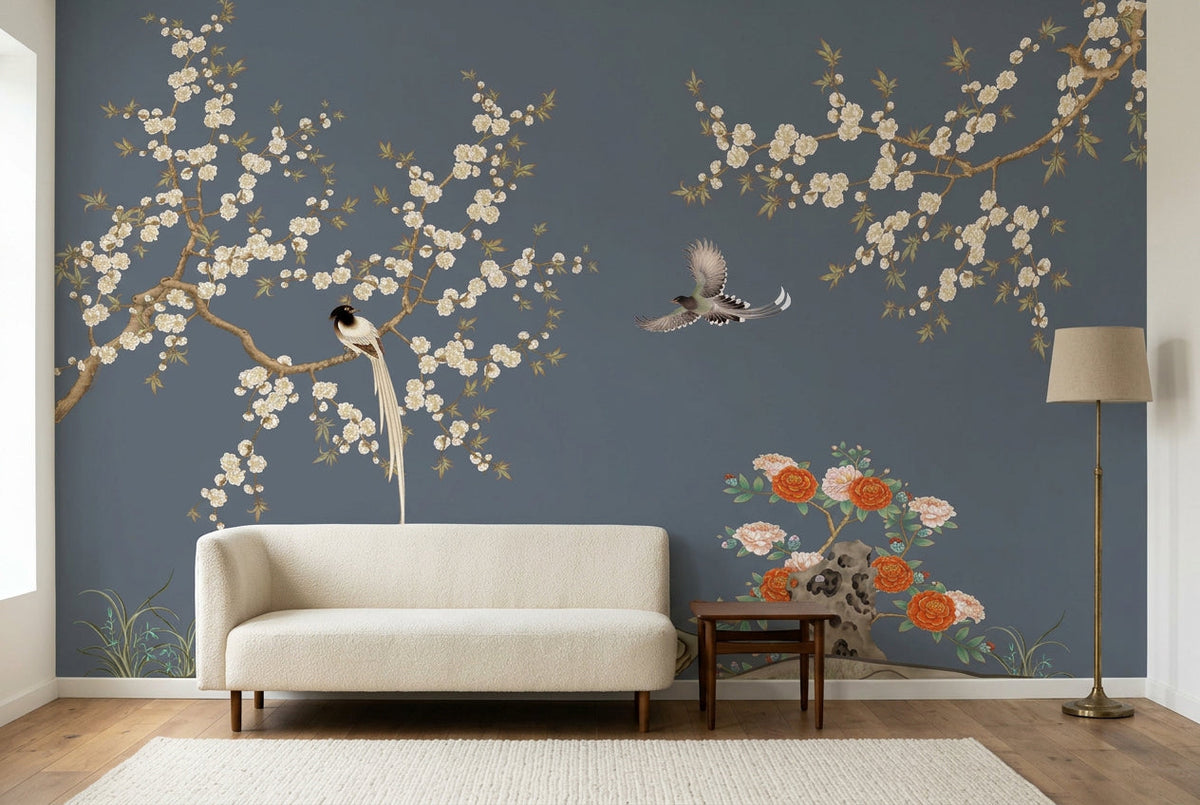
The Slate Blue Birds & Blossom Chinoiserie Wall Mural has a slate-blue background, pale blossom branches, birds and a lower floral arrangement with orange accents.
This is the stronger option if the homeowner wants to introduce blue while connecting with the cream curtains through the pale blossoms. It is more decorative than the landscape and introduces additional colours to consider.
Before choosing, check the birds and lower flowers against the sofa’s position. If a favourite detail would be covered or cropped out, compare a different artwork position before committing.
Option three: an abstract floral composition

The Abstract Flower Art Wall Mural uses large flowing shapes, dark botanical outlines, blue-green areas and peach and ochre accents.
This would be our choice if the homeowner wanted the mural to lead a more expressive colour scheme. Its broad shapes offer a different interpretation of botanical artwork from the detailed blossom scene.
The trade-off is that it moves furthest from the original neutral palette. Compare the whole composition with the furnishings, including where the dark outlines and stronger colour areas would fall after cropping.
Our verdict for this brief
Start with the monochrome landscape for a restrained scheme, choose the slate-blue scene for decorative botanical detail, or shortlist the abstract floral design for a more expressive colour direction.
There isn’t one objectively correct answer. The useful outcome is a clearer decision about how much colour you want, which composition you prefer and what will remain visible once the sofa is in place.
Ask AI to compare your actual shortlist
Once you have real products in mind, provide their links or images and ask a more focused question:
Compare these three mural designs for my room. Explain their differences in colour and composition, and identify what I need to check about scale and cropping. Separate visible details from anything you cannot verify. Don’t invent specifications or measurements.
Read the product pages yourself too. If the tool cannot access a page or inspect an image, it may not be comparing the information you intended. Ask it to say what it has actually used.
Keep visual ideas separate from ordering facts
A generated room image is an illustration, not an accurate ordering preview. It may change the artwork, furniture or proportions. Check printed colour expectations, dimensions and the final crop using the actual product information and ordering tools.
Keep the design format clear: a wall mural forms an overall image or composition across a wall; repeating-pattern wallpaper repeats a motif across its lengths. For a mural, an important feature may disappear behind furniture or be removed by cropping.
Material properties need separate checks. At Mural Wonder, Peel & Stick is the only self-adhesive material; Premium and Washable use adhesive. Don’t ask an AI tool to infer waterproofing, removability or surface suitability from a product image. Use the guidance for your selected material.
Check the details before ordering
Measure the wall yourself, account for openings and follow our current measuring guidance. Review the dimensions, selected material and artwork crop carefully before adding the mural to your basket. Our FAQs explain ordering and panel formats, and our installation guide covers preparation and application.
AI can help you explore possibilities and ask better questions. Your own taste, measurements and verified product information should guide the final order.
Browse our Floral Wall Murals collection for more botanical ideas, or email hello@muralwonder.co.uk for help with a particular design, material or artwork crop.